
Bench Warrants in Shelby County
In Shelby County, a bench warrant is a court order that grows out of a case already on file. Miss a hearing. Skip a citation appearance. Ignore a court order. Any of those can put a warrant on the docket, which is why the exact docket wording matters so much. Iowa publishes no single Shelby County bench-warrant list and no one local definition covering every court-directed custody order. Functionally, the entry lets a peace officer bring the named person before the court. One specific path sits in Iowa Code section 805.5: after a willful failure to appear on a citation, the court issues an arrest warrant for that offense, and the clerk sends the warrant and citation to the issuing agency. Other bench entries use other terms, so read each one in its docket context.
Find Shelby County Docket Events
Iowa Courts Online is the public starting point for any Shelby County case. Treat it as a docket search, not a certified warrant roster. A name search needs at least two letters of a last or firm name, and official help documents lookups by exact date of birth, case ID, or citation number. You can narrow results by county and case type. Scan dated events for an appearance, failure to appear, warrant, bond, return, or disposition. If the public view hides a document, the clerk can route a request or offer courthouse public-computer access, though sealed, confidential, or juvenile matters may stay off limits. The official court directory names the local record route. Iowa Courts Online finds a case; the filed docket and the issuing court still control its warrant status.
How a Bench Warrant Is Issued
The judge or magistrate acts inside a pending matter. A missed setting or ignored order gets recorded, and the court can direct law enforcement to produce the person. Under Iowa Code section 805.5, the clerk logs the transfer to the issuing agency, and after an arrest the warrant and citation go back to court so the offenses can move forward. That sequence keeps the issuing court and the holding agency separate. Iowa District Court, Shelby County owns the docket. The sheriff may serve a warrant, hold it, and show it in the possible-active report. Statewide, the IOWA System carries wanted-person data among authorized agencies, but no public self-search portal exists for it.
Shelby Bench Warrant Terms
Labels can look alike yet work differently. Shelby County publishes no local rule making capias, bench warrant, and failure-to-appear warrant interchangeable, so read the docket event first.
- Bench warrant
- A court-related custody order, often tied to a missed appearance or unmet duty.
- Failure to appear
- Willful nonappearance as directed by a citation can trigger a warrant under Iowa law.
- Capias
- A court-directed custody term with no distinct Shelby County public workflow found.
- Recall or quash
- A court action that withdraws or changes a warrant.
- Return
- The officer's report back to court about action under the warrant.
Ask the Shelby County clerk which entry appears, which court issued it, and which filing or appearance method applies.
Shelby Bench and Arrest Warrants
Both orders can authorize custody, but they start at different points. A Shelby County bench warrant grows from a court duty already in place. An arrest warrant under Iowa Code chapter 804 starts with a complaint and affidavits establishing probable cause before any duty exists.
| Feature | Bench warrant | Arrest warrant |
|---|---|---|
| Typical trigger | Missed appearance or duty | Probable-cause complaint |
| Case setting | Usually an existing docket | May begin a proceeding |
| Key record | Warrant or FTA event | Signed statutory warrant |
| Next step | Appearance, filing, or recall | Appearance, release, or bond |
The Shelby County arrest warrant record explains that separate instrument in detail.
Sheriff List Bench Warrant Limits
The Shelby County possible active-warrant page is an enforcement-side lead, nothing more. Its own warnings say status can change, accuracy is not guaranteed, and only authorized law enforcement can confirm information. Warrant details are not given by phone. Never confront anyone off that report. The list covers possible warrants the sheriff holds, and it is not described as a complete bench-warrant inventory. A warrant can be new, restricted, held elsewhere, or visible only through a docket event, and a web row can lag behind court action. Those limits are exactly why the report works as a lead and the issuing court supplies the confirmation tied to the right case.
Resolve a Shelby County Bench Warrant
Only the issuing court can resolve a Shelby County bench warrant. No office here publishes a walk-in warrant window, amnesty docket, surrender schedule, or county-specific recall form. Paying a ticket, visiting the jail, or vanishing from a web page does not itself end the order.
- Find the case or citation number and exact warrant or FTA docket entry.
- Contact the Shelby County Clerk of Court for filing, appearance, and access mechanics.
- Ask counsel about recall, quash, a scheduled appearance, bond, or planned surrender.
- Get written proof of release terms, a new date, or the filed disposition.
- Check the docket again because the sheriff display may not update at once.
Caution: An old Shelby County bench warrant is not shown to expire automatically; confirm status before relying on age or a missing web row.
Shelby Bond Is Not Recall
A bail endorsement or bond schedule governs release and appearance. It does not dismiss the case or recall a bench warrant. Under Iowa Code section 804.21, a person arrested on a warrant goes without unnecessary delay before the nearest or most accessible magistrate, subject to qualifying release rules, and a judicial officer keeps discretion. The Iowa Uniform Bond Schedule applies only when courts are not in session and the arrest is for a qualifying offense other than a forcible felony. Posted classes promise nothing for one Shelby County case. Verify the amount, recipient, and terms through official channels. Hang up on callers demanding prepaid cards, cryptocurrency, or personal data.
Shelby County Bench Warrant Court
Iowa runs one unified district-court system, so Shelby County has no municipal criminal court or justice-of-the-peace court of its own. A judicial magistrate handles simple misdemeanors, traffic citations, and municipal or county infractions. District associate judges carry broader authority. District judges can hear any district-court case. The Shelby County Clerk of Court, at 612 Court Street, Harlan, Iowa 51537, is the office to contact about a Shelby County warrant. Call 712-217-6737, fax 712-219-4255, or email CountyClerk.Shelby@iowacourts.gov. Ask which docket and judicial level holds your matter. Do not assume the District 4 chief judge issued a particular warrant; the court directory shows how the Shelby County route works and which judicial officer sits where.
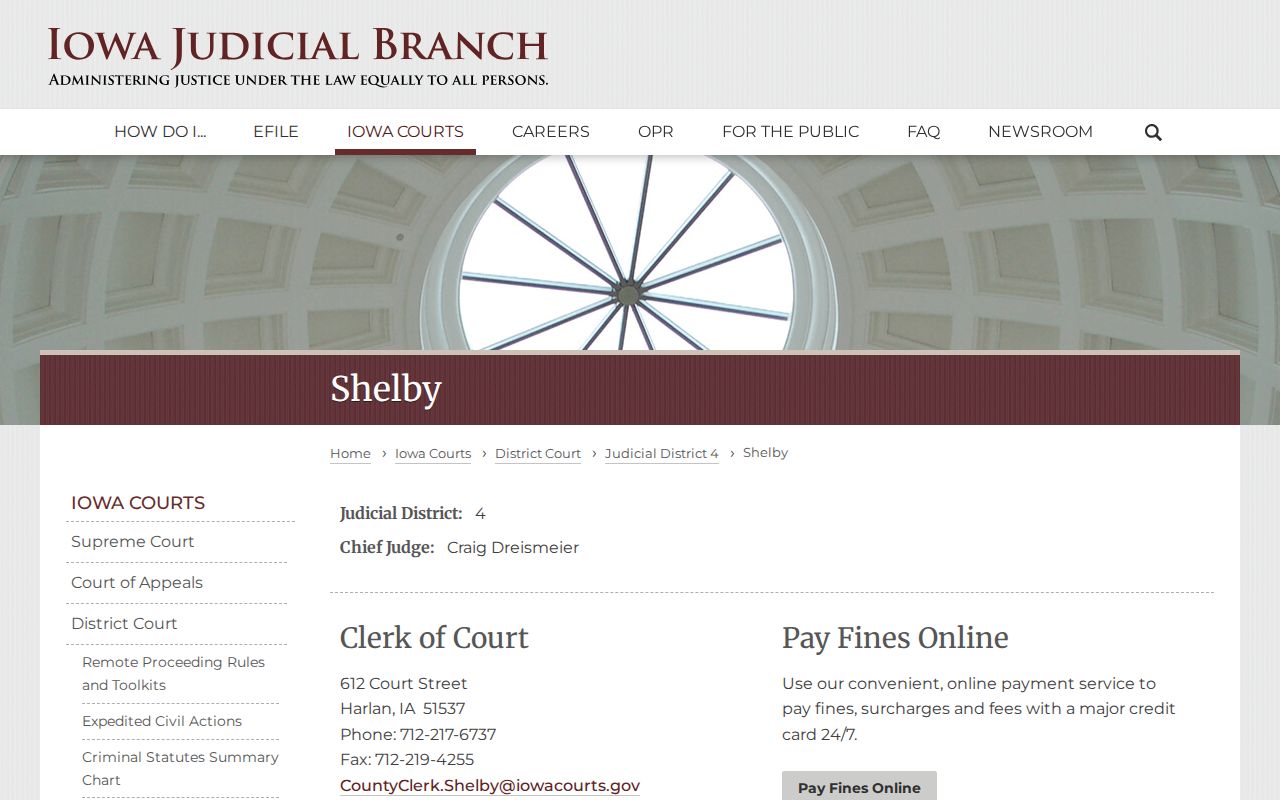
The clerk handles records and filing mechanics, while legal strategy belongs with counsel.
Written Shelby Warrant Confirmation
Keep every filed order, receipt, release term, and next appearance date in writing. The Iowa court forms page is the official search point for paperwork, though no Shelby-specific recall or quash form exists. The clerk can explain current filing mechanics. She cannot predict a ruling. A payment receipt proves payment, nothing more; it does not by itself prove a warrant recall. The same caution goes for bond paperwork and for a name vanishing from the sheriff report. Written docket confirmation ties the result to the right case and helps prevent another missed date. Iowa Judicial Branch records policy allows verbal or written requests during regular office hours. A complex request may need to be in writing, described well enough for staff to locate the record. Copying, postage, staff time, redaction review, or data work can all create charges. Shelby County sets no fixed bench warrant record fee. Ask for an estimate when the request may be broad. Court access still runs up against sealing, juvenile confidentiality, and protected investigative material. If a name match looks uncertain, use more than the name. Compare the county, case type, case number, filing date, appearance event, and listed charge. A similar name on a report is not enough. The clerk's record route helps prevent acting on the wrong case, while counsel can assess what the actual warrant entry requires. Note: Confidential and juvenile cases may not appear publicly, so restricted access must not be read as proof that no order exists.